
Why I Write About War
An author's personal reflection on the arguably "worst" of subject matters...

It’s such a depressing topic. Virtually nobody wants to read about it aside from middle school social studies teachers. It doesn’t feel relevant to most people’s lives—not in an experiential sense anyways. And, everyone already knows: war is hell, awful, horrible, pointless, probably tragically endemic to the human condition. All the great war books have already been penned—mostly by men, though women have always had their war stories, too.
I don’t know why I bother, sometimes.
Perhaps I’ve made a terrible mistake—focusing so much of my writing on this one topic. Perhaps I should have continued in the sci-fi and fantasy realm, which is where I initially wanted to publish. I wrote a sci-fi novella that takes place a thousand years in the future upon a much-diminished earth, in terms of human population, but one where nature had resumed its original, almost Edenic, if not subtly malicious, role. But that project deservedly ended up in the shoe box under the bed. Great concept/poor execution kinda thing that any budding author pumps out by the bushel-load thinking they’re the next N.K. Jemisin…
Then another book project came along: a second sci-fi story but which takes place in a fictional geography based upon the Great Basin territory of northern Nevada and eastern Oregon and a line—a border wall—running through the middle of it. Only, the wall isn’t meant to keep people out; it’s meant to keep people in.
Something happened with that second book project.
I made the switch: I would be a veteran author.
I didn’t realize it until after completing multiple drafts and, yes, finally setting it aside, too. But looking back on that second book project about the wall, I realized that I had created scenes with (1) a highly militarized local police force, (2) a field of rotting military equipment, and (3) a final scene relying heavily upon the ballistics of a .50 cal…
It hit me: the military stuff, my own military experience as an infantryman, it was finding its way into stories I thought had nothing to do with it…
I thought I had left my seven years active service and two deployments behind me…
Then, once I discovered that there were veteran-welcoming literary magazines such as Line of Advance and Wrath-Bearing Tree, and that they sought out the kind of work I found myself producing more and more of, veritably drenching myself in war-reading and war-writing, I made the switch: I would be a veteran author. I would write about what I knew, or at least what I thought I knew because I had experienced it:
War.
The switch wasn’t overnight.
In a way, like Tim O’Brien, I eschew the label war writer, though that’s exactly what people will think of you when you write about war. (Sure, O’Brien’s written other works of fiction. But what is he really known for?)
I once participated in an interview with a graduate student who happened across one of my short stories, A Sleeping Peace, in Wrath-Bearing Tree. He asked me why I wrote about war. Why was war such a continual go-to topic for me?
I told him: “Because I realized I’d be labeled as a veteran author (or as a war writer) whether I wanted to be or not. So I might as well own it.”
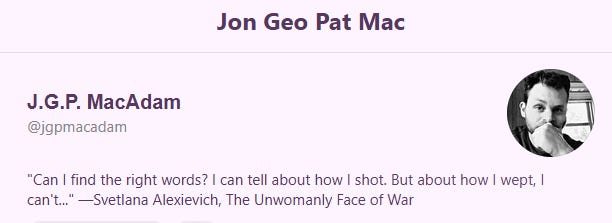
It’s not easy to write about war. Hell, it’s not easy to write well about any topic. But I have those words from Svetlana’s Alexievich’s The Unwomanly Face of War copy/pasted in the small text of my Substack profile for a reason:
“Can I find the right words? I can tell about how I shot. But about how I wept, I can’t...”
As a former grunt, a ground-pounder, a member of a professional force of killers who learn, often at a young age, to shout at the top of their lungs that the sky is blue because “God loves the infantry!” I’m continually rehashing events, comparing them to other, more current events, or those that I read about, all those words of past wars ever-fading further onto the far shore of history—all of it, in an effort to understand. To understand why I did what I did or why any soldier does what he does or why any conflict had to happen in the first place…
Yes, so much has already been written about war. Yes, we already know: war is hell, awful, horrible, supposed to be a measure of last resort. But the stories we’ve already told haven’t stopped war, have they? War as an institution. War, not as endemic to the human condition, or to us as a species, but something we condition into ourselves as members of a society, a nation, a civilization. Something we choose.
Such subject matter sometimes causes a reader to turn away, to put down the book, unable to take anymore of it—and it’s supposed to.
Some books, perhaps the most important books, show us a side of ourselves we otherwise do not want to see.
War as an “unputdownable” thriller or “breathless” page-turner doesn’t necessarily get to the reality of the thing, the truth of it. It’s just more of the war-as-entertainment that you get on cable news or out of Hollywood or on certain feeds on social media. Plus, not all books are supposed to be The Da Vinci Code. Not all books are meant to cast a spell of enchantment or escape. Some books, perhaps the most important books, show us a side of ourselves we otherwise do not want to see. Cast a ghastly reflection upon ourselves. But do so with a purpose: to say, see? See what happens? See what we’re capable of? See what all your commercials and docu-series and Instagram profiles about military badassery lead to? See what your national media outlets don’t report on? See this truth?
But, in reality, perhaps the real reason I write about war is far more personal: it gives me a sense of purpose.
(Note: I don’t say how effective that purpose may or may not ultimately be…)
But it’s a sense of purpose, and isn’t that what so many wore-out combat vets like yours truly so often struggle with? Simply finding something to do. Something with meaning. Something worth living for. A simple story to tell.
Maybe for that reason and no other, I keep telling it.
Ending on "it gives me a sense of purpose" with the parenthetical hedge about effectiveness is the honest version of the answer. A weaker close would have claimed the work makes a difference. This one names the function the writing serves for the writer — something to do, something worth living for — and lets that be enough. The structural patience to land there instead of on a larger claim is what makes the piece feel earned rather than positioned.
Write what you are passionate about; the right readers will appreciate it. Great quote: 'Some books, perhaps the most important books, show us a side of ourselves we otherwise do not want to see.'